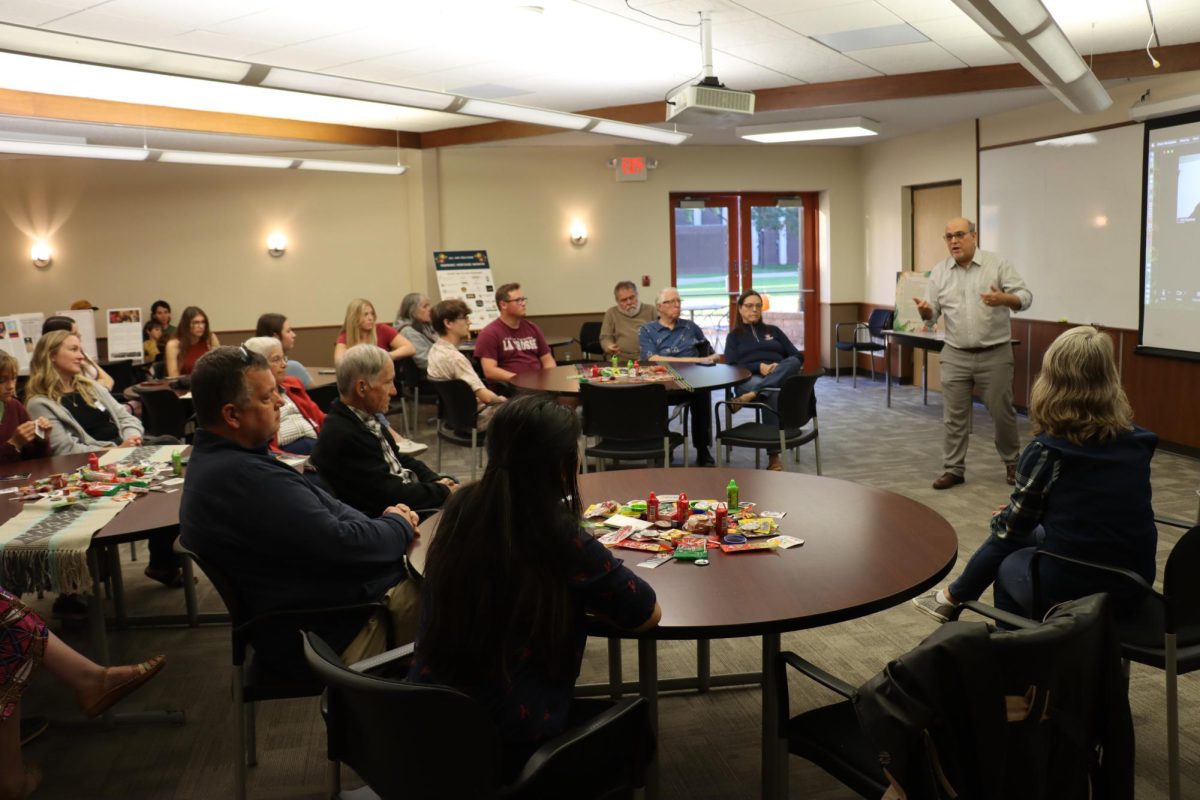
Viterbo University kicked off a vibrant celebration of the Spanish major hosted by the English and World Languages Department in Brophy Center 123 from 5:00 to 7:00 p.m. on October 11, 2025. With the band Cumbia Cachaca setting the rhythm, the event honored 60 years of Spanish instruction and 30 years of Spanish as a major marking a deep legacy deeply for the campus community.
“What it means, what it signifies for the campus,” said Dr. Michelle Pinzl, an associate professor in World Languages and the coordinator of the Interpreting Studies program, “is that we have made a concerted effort to raise up the importance of learning another language, particularly Spanish, in this space.” For Pinzl, language and culture are inseparable. “You can’t divide language from culture…The history of teaching Spanish on this campus really illuminates the fact that we do care about other cultures and about being hospitable to other cultures and trying to get close to other cultures and to be open and to learn new things outside of what is mainstream U.S. culture.”
The Spanish program has long shaped the university’s cultural and academic landscape. “Thanks to this program, we’ve had a number of Hispanic Heritage events over the recent years that have really brought to light the beauty and the importance of Latino culture on this campus,” Pinzl noted. “It has been kind of a beacon of light in terms of diversity, equity and inclusion, even before those three terms together meant what they mean today.”
The celebration’s music and food weren’t just festive; they were foundational. “Music and food are just such an important pillar of any culture,” she said. “When you bring music and food into a space, almost automatically, we’re creating a community.” For Pinzl, these elements deepen language learning. “If we’re just all about memorizing vocabulary and using language as a code to communicate, and we didn’t incorporate all of those cultural things… you wouldn’t get the feeling—the actual soul—of the language.”
The program has also fostered belonging through intentional outreach. “We have made a targeted effort to recruit and retain a more diverse student body,” she explained, highlighting the creation of Avanza, a student club “specifically intended to welcome in and allow Latino students to feel like they have a space for them on campus.”
As for what faculty hope students carry forward, Pinzl was clear: “An openness to learning about differences and learning about different people and different cultures and different ideas and different concepts.” She added, “I would also love if the graduates of the Spanish program continue to integrate themselves into spaces that are Spanish speaking and just continue with these values that are so pivotal for this university—contemplation and hospitality and service and integrity.”
“We would love to have more students taking Spanish classes at Viterbo… and I would be thrilled to meet new students who are interested in studying language or culture.”